
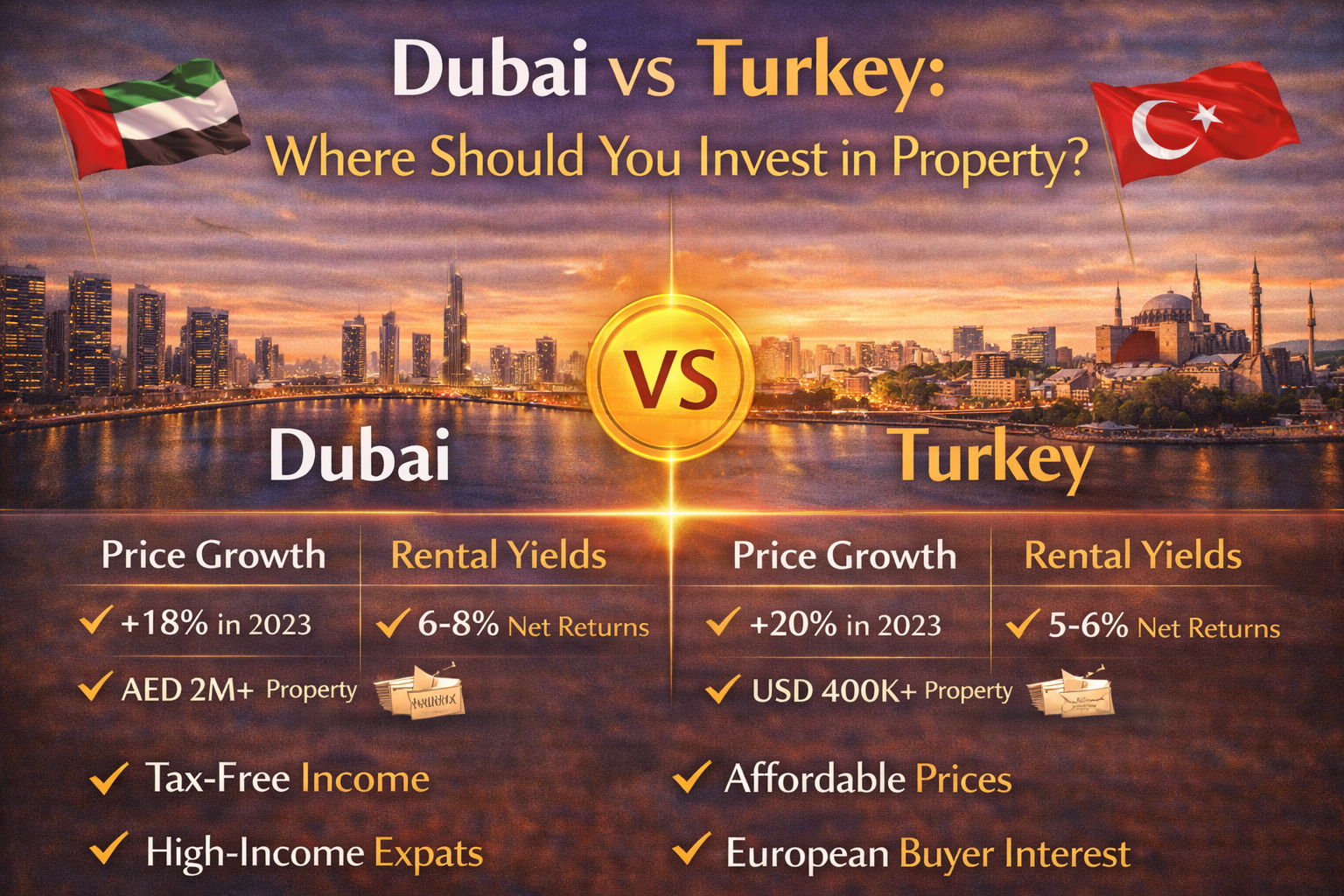
Global investors often compare emerging real estate markets before making a decision. One of the most common questions in 2026 is: Dubai vs Turkey: Where Should You Invest in Property?
Both markets offer attractive entry points, residency options, and capital appreciation potential. However, they differ significantly in rental yield, currency stability, regulation, and long-term growth prospects.
This guide provides a data-driven comparison to help investors choose the right destination.
Direct Answer: Dubai vs Turkey: Where Should You Invest in Property?
Dubai generally offers higher rental yield, stronger regulatory protection, and tax-free income, making it attractive for income-focused investors. Turkey offers lower entry prices and citizenship opportunities but carries higher currency risk and market volatility. The best choice depends on your risk tolerance and investment goals.
Dubai vs Turkey: Where Should You Invest in Property? (Key Comparison Factors)
1. Rental Yield & Cash Flow
Dubai
Dubai property investment typically generates rental yields between 6% and 9% in mid-market areas such as:
- Jumeirah Village Circle
- Business Bay
- Dubai Marina
The absence of income tax increases net returns.
Turkey
Rental yields in Turkey vary widely:
- Istanbul city center: 4–6%
- Coastal areas: 3–5%
However, rental returns are influenced by currency fluctuations and inflation.
Comparison Table: Rental Yield
| Market | Average Rental Yield | Tax on Rental Income |
|---|---|---|
| Dubai | 6–9% | 0% |
| Turkey | 3–6% | Yes |
Dubai clearly outperforms in rental yield stability.
2. Currency & Economic Stability
Dubai (UAE Dirham)
- Pegged to the US Dollar
- Stable exchange rate
- Lower currency risk
Turkey (Turkish Lira)
- High volatility
- Inflation impact
- Exchange rate fluctuations
Currency risk directly affects foreign investor ROI.
3. Property Prices & Entry Cost
Dubai
- Studio apartments from AED 450,000
- Mid-market 1BR from AED 700,000
- Luxury options AED 2M+
Turkey
- Apartments from $80,000–150,000 in secondary cities
- Prime Istanbul units higher
Turkey offers lower entry cost, but price growth depends on economic stability.
4. Residency & Citizenship Programs
UAE Residency
Dubai property investment can qualify for:
- AED 750,000 → Residency visa
- AED 2M → 10-year Golden Visa
This provides long-term residency but not citizenship.
Turkey Citizenship
Turkey offers:
- Citizenship by investment from $400,000 property purchase
However, investors must hold the property for at least three years.
Comparison Table: Residency Options
| Country | Minimum Investment | Benefit |
|---|---|---|
| UAE | AED 750K | Residency |
| UAE | AED 2M | 10-Year Golden Visa |
| Turkey | $400K | Citizenship |
5. Market Transparency & Regulation
Dubai
- Escrow protection
- Regulated by RERA
- Transparent title registration
- Strong investor protection
Turkey
- Legal framework exists
- Higher regional variation
- Due diligence is critical
Dubai’s regulatory system is considered more transparent.
6. Capital Appreciation Potential
Dubai
Capital growth supported by:
- Infrastructure expansion
- Corporate relocation
- Expo and tourism growth
- Population increase
Luxury waterfront areas such as Dubai Creek Harbour show strong appreciation trends.
Turkey
Appreciation may occur in:
- Istanbul
- Antalya
- Bodrum
However, currency depreciation may offset gains.
Risk Comparison
| Risk Factor | Dubai | Turkey |
|---|---|---|
| Currency Risk | Low | High |
| Political Risk | Low | Medium |
| Market Volatility | Moderate | High |
| Rental Stability | Strong | Variable |
Dubai presents lower macroeconomic risk overall.
Advantages & Disadvantages
Dubai Advantages
- Tax-free rental income
- High rental yield
- Strong legal framework
- Currency stability
Dubai Disadvantages
- Higher entry price
- No direct citizenship
Turkey Advantages
- Lower entry cost
- Citizenship opportunity
Turkey Disadvantages
- Currency volatility
- Inflation impact
- Lower rental yield
Who Should Invest Where?
Choose Dubai If You:
- Want stable rental income
- Prefer tax-free returns
- Seek long-term residency
- Value regulatory transparency
Choose Turkey If You:
- Seek citizenship
- Accept higher risk
- Want lower entry cost
Internal Linking Suggestions
- Best Areas to Invest in Dubai 2026
- Minimum Investment to Get a Dubai Golden Visa
- Top High Rental Yield Areas in Dubai
- Dubai Property Market Forecast 2026
2026 Investment Outlook
Dubai’s real estate market continues to benefit from:
- Strong foreign investment
- Tourism growth
- Business relocation
- Stable currency
Turkey remains attractive for citizenship-focused investors but carries higher macroeconomic uncertainty.
Conclusion
The question Dubai vs Turkey: Where Should You Invest in Property? ultimately depends on your investment priorities.
If your focus is rental yield, currency stability, and long-term market resilience, Dubai offers a safer and more structured environment. If citizenship is your primary goal and you accept higher risk, Turkey may be suitable.
For tailored investment advice aligned with your financial objectives, consult experienced property specialists before making your decision.
FAQ Section
1. Which country offers higher rental yield?
Dubai generally offers higher and more stable rental yields compared to Turkey.
2. Is Dubai safer than Turkey for property investment?
Dubai has stronger regulatory protection and currency stability.
3. Does Turkey offer citizenship?
Yes, property purchases above $400,000 can qualify for Turkish citizenship.
4. Can Dubai property investment lead to citizenship?
No, but it can lead to long-term residency visas.
5. Which market has lower entry cost?
Turkey generally offers lower entry prices.




Join The Discussion