
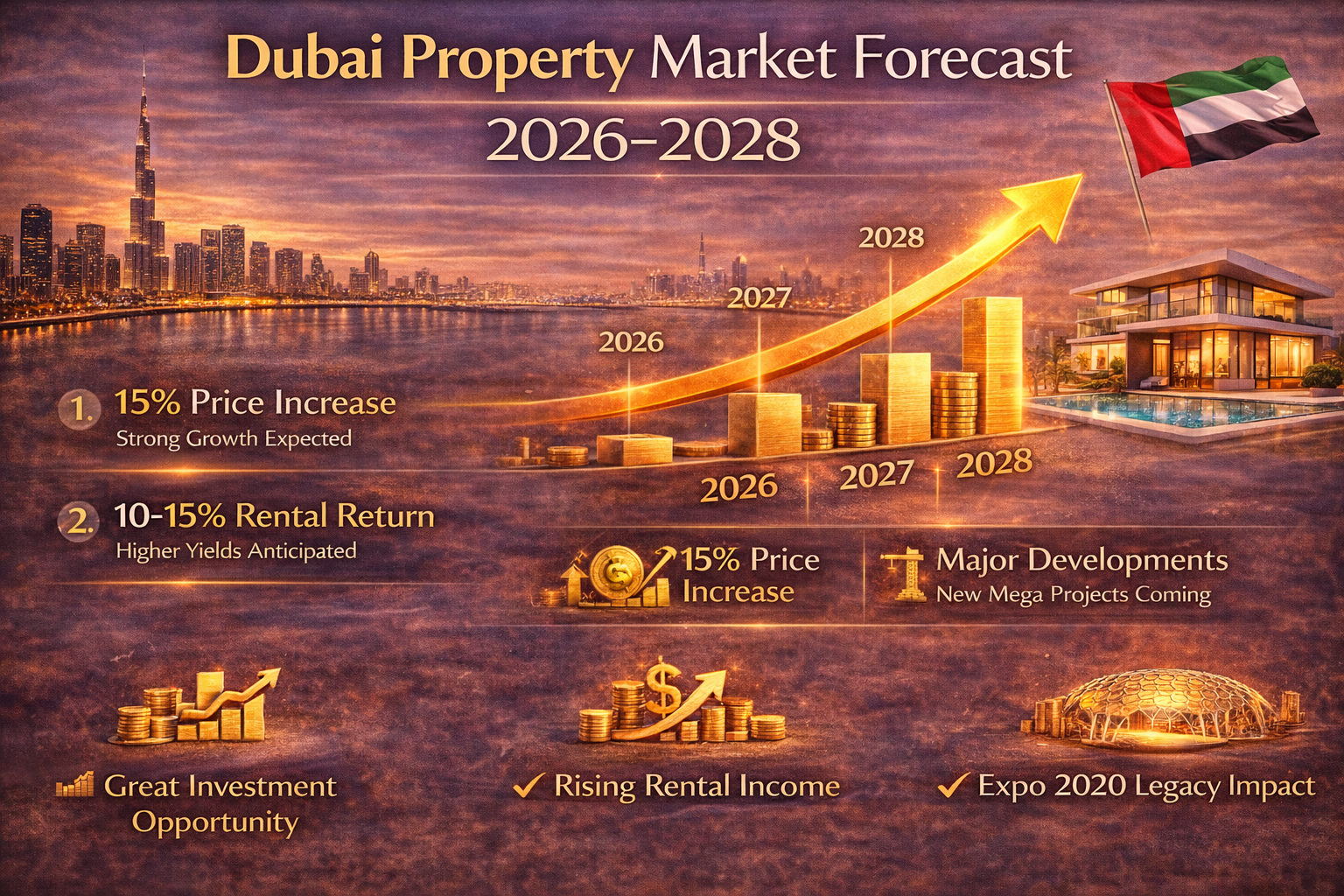
The Dubai Property Market Forecast 2026–2028 is one of the most searched topics among global investors today. After several years of strong price growth and record transaction volumes, many are asking: will Dubai real estate continue to rise, stabilize, or correct?
In 2026, Dubai property investment remains attractive due to high rental yield, tax-free income, and strong population growth. However, understanding future supply, demand dynamics, and economic drivers is critical for making informed decisions between 2026 and 2028.
This forecast breaks down expected trends, risks, and opportunities.
Direct Answer: What Is the Dubai Property Market Forecast 2026–2028?
The Dubai property market forecast for 2026–2028 suggests moderate price growth of 3–7% annually in prime areas, stable rental yields between 6–8%, and continued demand driven by residency incentives, population growth, and foreign investment. Oversupply risks may affect select mid-market communities.
Dubai Property Market Forecast 2026–2028: Key Trends
1. Price Growth Outlook
After strong growth between 2022 and 2025, analysts expect:
| Year | Expected Price Growth |
|---|---|
| 2026 | 5–7% (prime areas) |
| 2027 | 3–6% |
| 2028 | 3–5% |
Prime communities such as Palm Jumeirah and Dubai Marina are likely to outperform due to limited supply.
Mid-market areas may see slower growth depending on new project completions.
2. Rental Yield Expectations
Dubai continues to offer strong rental yield compared to global cities.
| Area | Average Rental Yield (2026) |
|---|---|
| Jumeirah Village Circle | 7–9% |
| Business Bay | 6–8% |
| Dubai Marina | 6–8% |
Rental yields are expected to stabilize rather than spike dramatically.
3. Population Growth & Demand Drivers
Dubai’s population is projected to exceed 4 million by 2028.
Demand drivers include:
- Corporate relocations
- Remote worker visas
- Golden Visa incentives
- Infrastructure expansion
These factors support long-term real estate market stability.
4. Supply Pipeline 2026–2028
New project launches remain strong, particularly in off-plan segments.
Potential Risks
- Oversupply in specific mid-market clusters
- Increased competition among landlords
- Pressure on short-term rental yields
Investors must evaluate supply carefully before purchasing.
Off-Plan vs Ready Market Outlook
| Segment | Forecast Trend |
|---|---|
| Off-Plan | Stable demand, slower appreciation |
| Ready | Strong rental demand, steady growth |
Off-plan properties may face more competition as new supply enters the market.
Luxury Segment Forecast
Luxury real estate continues attracting ultra-high-net-worth individuals.
Communities such as:
- Palm Jumeirah
- Dubai Hills Estate
are expected to maintain price resilience due to limited premium inventory.
Mid-Market Forecast
Mid-market communities like JVC and Dubai Silicon Oasis may see:
- Slower appreciation
- Stable rental yield
- Competitive tenant market
Investors should focus on quality projects and reputable developers.
Economic Factors Influencing the Forecast
- Global interest rates
- Oil price stability
- Foreign direct investment
- UAE economic diversification
Dubai’s diversified economy reduces reliance on a single sector.
Advantages of Investing 2026–2028
- High rental yield compared to Europe
- No income tax
- Residency-linked investment
- Strong legal framework
Risks to Monitor
- Global recession impact
- Geopolitical instability
- Overdevelopment in certain districts
Risk management is key to successful Dubai property investment.
Capital Appreciation vs Cash Flow Strategy
| Strategy | Suitable Market Phase |
|---|---|
| Capital Growth | Early project launches |
| Rental Income | Established communities |
Balanced portfolios may include both.
Golden Visa Impact on Market
The UAE’s long-term residency program continues attracting investors purchasing:
- AED 2 million+ properties
- Luxury waterfront homes
Residency demand supports price stability in prime areas.
Internal Linking Suggestions
- Is Now a Good Time to Buy Property in Dubai?
- Best Areas in Dubai for Rental Income in 2026
- Off-Plan vs Ready Property in Dubai
- How to Calculate ROI on Dubai Property Investment
What Investors Should Do in 2026
- Focus on supply-demand balance
- Prioritize established communities
- Calculate net ROI carefully
- Avoid speculative short-term flips
Long-term strategy outperforms short-term speculation.
Conclusion
The Dubai Property Market Forecast 2026–2028 points toward moderate, sustainable growth rather than explosive price spikes. Prime waterfront and luxury communities are likely to remain resilient, while mid-market areas may experience stabilization.
Dubai continues to offer competitive rental yield, tax advantages, and residency benefits, making it one of the most attractive global real estate markets.
For investors, the key is strategic selection, realistic ROI expectations, and long-term positioning between 2026 and 2028.
FAQ Section
1. Will Dubai property prices fall in 2026?
A major crash is unlikely, but growth may moderate in some areas.
2. Is rental yield expected to rise?
Rental yield is expected to stabilize between 6–8%.
3. Which segment will perform best?
Prime and waterfront communities are expected to remain strong.
4. Is off-plan risky between 2026–2028?
Risk depends on supply levels and developer quality.
5. Should investors buy now or wait?
Timing depends on individual strategy and liquidity.




Join The Discussion