
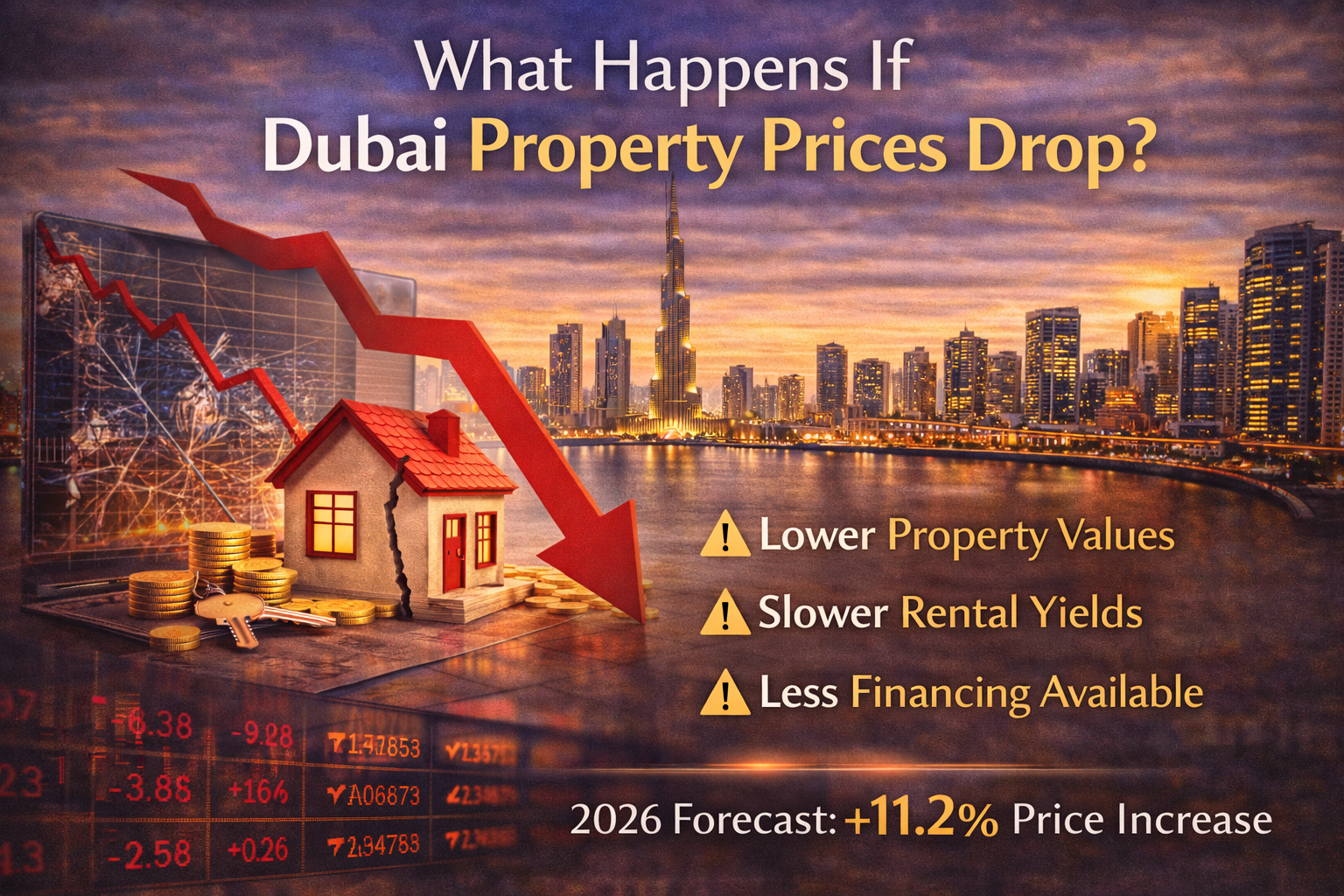
Dubai’s real estate market has delivered strong growth in recent years. But every investor eventually asks: What Happens If Dubai Property Prices Drop?
Understanding how price corrections affect rental yield, equity, mortgages, and long-term returns is critical for anyone involved in Dubai property investment in 2026.
This guide explains the financial impact of a market dip and how investors can protect their portfolios.
Direct Answer: What Happens If Dubai Property Prices Drop?
If Dubai property prices drop, property values decline temporarily, but rental income may remain stable in high-demand areas. Long-term investors focused on rental yield and holding power are often less affected, while short-term speculators and highly leveraged buyers face higher risk.
Why Property Prices Can Drop
Even in a strong real estate market, corrections happen due to:
- Oversupply of new units
- Global economic slowdowns
- Interest rate increases
- Reduced foreign investment
- Market cycle adjustments
Price corrections are part of normal market cycles.
Impact on Different Types of Investors
1. Cash Buyers
If prices fall:
- Property value may decline temporarily
- Rental income may continue
- Long-term recovery is possible
Cash investors with strong rental yield often experience lower stress during downturns.
2. Mortgage Buyers
If Dubai property prices drop:
- Loan-to-value ratio increases
- Refinancing becomes harder
- Negative equity risk increases
High leverage increases vulnerability during price declines.
Rental Yield During Market Corrections
Rental yield can sometimes remain stable even when prices fall.
Example high-demand areas:
- Jumeirah Village Circle
- Dubai Marina
- Business Bay
If rental demand remains strong, income continues despite valuation drops.
Price Drop vs Rental Income: Comparison
| Scenario | Property Value | Rental Income | Investor Impact |
|---|---|---|---|
| 5% Drop | Lower equity | Stable | Manageable |
| 10% Drop | Significant equity loss | Slight impact | Medium risk |
| 20% Drop | Major correction | Potential rent decline | High risk (leveraged buyers) |
What Happens If Dubai Property Prices Drop? Short-Term vs Long-Term View
Short-Term Impact
- Reduced resale value
- Buyer hesitation
- Slower transactions
Long-Term Impact
- Market stabilization
- Recovery driven by demand
- Opportunity to buy below peak
Historically, Dubai’s property market has recovered from corrections due to economic growth and foreign investment demand.
Off-Plan Investors During a Price Drop
If Dubai property prices drop during construction:
- Resale before handover becomes difficult
- Capital appreciation expectations shrink
- Developers may adjust pricing strategy
However, if bought at pre-launch pricing, early investors may still maintain a buffer.
Ready Property Investors During a Price Drop
Ready property owners benefit from:
- Immediate rental income
- Established market value
- More predictable cash flow
Income-focused investors are generally less exposed to short-term valuation changes.
Economic Fundamentals in 2026
Dubai’s economy remains supported by:
- Tourism growth
- Corporate relocation
- Infrastructure expansion
- Investor visa demand
These factors provide a foundation for long-term recovery if prices adjust.
Advantages of Buying During a Price Drop
A price decline can create opportunities:
- Discounted entry prices
- Higher potential future appreciation
- Stronger negotiation leverage
Savvy investors often enter during corrections.
Disadvantages of a Price Drop
- Reduced equity value
- Possible rental softening
- Slower resale liquidity
Risk tolerance matters.
Risk Mitigation Strategies
To reduce exposure if Dubai property prices drop:
- Focus on high-demand communities.
- Maintain manageable mortgage ratios.
- Prioritize rental yield above 7%.
- Diversify across property types.
Role of UAE Residency & Investor Visa
Property investors qualifying for:
- AED 750,000 residency threshold
- AED 2 million Golden Visa
Often hold long-term investment horizons, reducing panic selling during downturns.
Residency-linked demand adds market stability.
Internal Linking Suggestions
- Is Dubai Real Estate a Safe Investment in 2026?
- Dubai Property Market Forecast 2026
- Off-Plan vs Ready Property in Dubai
- Top High Rental Yield Areas in Dubai
Historical Perspective
Dubai’s market experienced corrections in:
- 2009 (global financial crisis)
- 2015–2018 (oversupply cycle)
- 2020 (pandemic adjustment)
Each time, recovery followed due to infrastructure growth and foreign demand.
Should You Sell If Prices Drop?
Selling during a correction often locks in losses. Long-term investors typically benefit from holding through cycles.
The key question is not What Happens If Dubai Property Prices Drop?, but whether your investment strategy aligns with long-term fundamentals.
Conclusion
So, What Happens If Dubai Property Prices Drop? In most cases, short-term equity declines occur, but rental yield in strong areas remains resilient. Investors with a long-term outlook and diversified portfolios are better positioned to navigate market fluctuations.
Dubai’s regulated framework, tax advantages, and residency incentives continue to support long-term stability.
If you’re planning to invest or adjust your portfolio, consult experienced advisors to assess risk exposure and optimize your strategy.
FAQ Section
1. Is a property price drop common in Dubai?
Yes, like all real estate markets, Dubai experiences cycles of growth and correction.
2. Does rental income drop when property prices fall?
Not necessarily. Rental demand may remain stable in high-demand areas.
3. Should I buy during a market correction?
Buying during a correction can provide strong long-term appreciation potential.
4. Is mortgage risk higher during price drops?
Yes, highly leveraged investors face greater risk if property values decline.
5. Does residency eligibility change if prices drop?
No. Residency eligibility depends on purchase value at acquisition.




Join The Discussion